Part 1:
Sunk Cost Fallacy
Someone puts in time and money and therefore they will still do it whether they want to or not. An example would be you do not want to go to the movies but you have already paid for the ticket therefore you will go. I actually did this myself this week. My friend and I decided we wanted to go to the movies. We called ahead and made sure there were tickets and reserved two. Later in the day I decided I was not in the mood because I knew it was going to be a sad movie. But I had already reserved the ticket and knew it would not be nice to not go, plus my friend also had my money for it!
Part 2:
Intuition can act as both a lens and as a filter when making a moral or ethical decision. It can act as a lens in the sense of moral things because it is our gut feeling. Moral means that is what we believe is right. If you see on the media something tragic happens, your moral compass would generally make you feel empathy for the people in the tragedy. It helps you understand things better and will also make you want to help. Ethically it is a lens because ethical decisions deal with religion a lot of times. In the bible it states things like you shall not seduce your neighbors wife (of course not in those words). Due to religion, intuitively we think that cheating on a persons husband/wife is bad, no question.
Intuition also can act as a filter though. A good example would be the media. A lot of times the media shows us only what they want us to believe and therefore does not show the truth about what is happening in the world at that moment. Because of only seeing part of the story, our intuition does not allow us to see the rest of what is happening. We make conclusions about what was said on the news and that is it. If we see anything else we immediately pin it as wrong and lies, whether that is true or not. Ethically it can not allow us to see clearly because we want to believe what the bible says. This kind of goes hand in hand with the gay marriage debate. In the bible it says that marriage is between a man and a woman. Many Christians , not all, believe intuitively that when the word marriage is said they think of a man and woman not a man and a man. Another place where there is a filter is on the LGBT side. Many Christians, again not all, just do not wish for it to be called marriage and instead want it to be called a civil union, but LGBT sometimes will not listen to this side and pin Christians as hateful when this is not true. there are Christians who are, but there are also a good portion who are not.
Part 3: \
When someone has knowledge they do have an ethical responsibility to share their knowledge depending on the situation. In a situation where someone knew that there was going to be an attack on somewhere and knew that hundreds of people would be killed in the flames, then it is their responsibility is to tell someone who could save these people. In the sense of knowing the recipe to a wonderful lemon square recipe it is not their ethical responsibility to do share this knowledge, as nice as it would have been for them to share it before they died.
Friday, March 6, 2015

Wednesday, February 4, 2015
TOK presentation feedback
#1 Feedback responses
I looked at your comments and the one that stuck out to me most was the one about how I should have used only one video and went in depth on that video. I totally agree with that. I had in my head that I wanted to fit a lot of information and then when the presentation came together my mind went completely blank. I had practiced at home and knew what I wanted to say, but again I got nervous! I think by simplifying that part and only doing one video it would have allowed me to not worry about the time period and really have a better understanding. To be honest, my topic ended up confusing me and it should not have. I think that I should have looked into a deeper topic that had a bit more sides to it and maybe I should have come in during a lunch period to talk to you because I was so confused. Also, I was very confused by the TK-PPD and I really should have come in and talked to you about it and maybe even doing it with you to really understand what I wanted to get across on it.
#2 Questions.
Is there any way that I can meet with you one day to really understand how to do the TK-PPD? I do not want to just hold it off until next year when it really counts a lot towards my IB grade and have no clue what to do.
I looked at your comments and the one that stuck out to me most was the one about how I should have used only one video and went in depth on that video. I totally agree with that. I had in my head that I wanted to fit a lot of information and then when the presentation came together my mind went completely blank. I had practiced at home and knew what I wanted to say, but again I got nervous! I think by simplifying that part and only doing one video it would have allowed me to not worry about the time period and really have a better understanding. To be honest, my topic ended up confusing me and it should not have. I think that I should have looked into a deeper topic that had a bit more sides to it and maybe I should have come in during a lunch period to talk to you because I was so confused. Also, I was very confused by the TK-PPD and I really should have come in and talked to you about it and maybe even doing it with you to really understand what I wanted to get across on it.
#2 Questions.
Is there any way that I can meet with you one day to really understand how to do the TK-PPD? I do not want to just hold it off until next year when it really counts a lot towards my IB grade and have no clue what to do.
Friday, December 5, 2014
Indigenous people
Part A: Research
geographic location, language(s) spoken, population, spiritual practices/religion, schooling/education, ethics, values, practices, scientific knowledge, etc.
Tukano
The Indians who live on the banks of the Uaupés River and its tributaries - the Tiquié, Papuri, Querari and other minor rivers - today belong to 17 ethnic groups, many of which also live in Colombia, in the Uaupés and Apaporis river basins (tributary of the Japurá), the principal tributary of which is the Pira-Paraná River.
Tukano proper language. There are about 15 other languages but the majority of speakers in the Tukano tribe speak Tukano proper. Also many indigenous groups around the Tukano tribe speak this language as well. 20, 000 people speak this language.
They call themselves Ye"pâ-masa or Daséa. This is the most numerous group of the Eastern Tukanoan language family. They are concentrated primarily on the Tiquié, Papuri and Uaupés rivers; but they are also living on the Rio Negro, below the mouth of the Uaupés, and also in the city of São Gabriel
The Tukano are traditional manufacturers of ritual benches, made of wood (sorva) and painted, on the seat of the bench, with geometric motifs similar to those found in weaving. The bench is a highly valued object, obligatorily used in cerimonies and rituals, where the leaders, the kumua (chanters) e bayá (cerimonial chiefs) sit.
They believe in rebirth and reincarnation
Animals are seen as people in their religion
All creatures that can see and hear, that communicate with their own kind, and that act intentionally are "people" - but people of different kinds. They are different because they have different bodies, habits and behaviours and see things from different bodily perspectives. Just as stars see living humans as dead spirits, so also do animals see humans as animals. To vulture eyes, when humans go fishing, they fish in rotting corpses and catch maggots; to jaguar eyes, humans are dangerous predators who drink blood as beer; to fish it is wonder that humans can breathe underwater. But of course humans see things the other way round.
küni-oka "weapons or shields"
Men and women both have gender roles. the man is expected to go out and hunt while the woman are expected to stay home and care for the children (because they gave birth to them) and to deal with all meals when the men return with their huntings and gatherings.
All adult men are shamans to a point
3 pictures

Art is very important in Tukano culture. Many times elders take time out of their day to teach the youth how to create such beautiful artwork as well as share stories with the youth as they do so. This makes the community a very engaging community who cares about each other.
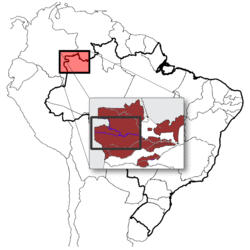
Here this is a map of south america and it shows where exactly the Tukano live. It gives those who do not know by words where the Tukano live a visual. Here this is on the border of Columbia and Brazil.

The caxiri is a welcoming dance that is very important in the Tukano culture. Their religion and culture is valued above all else. Because of this it makes them a very welcoming and warm tribe.
Paragraph on the Tukano
Personally, I felt the Tukano was a really interesting tribe to learn about. First off, they live on the border of Columbia and Brazil, specifically along the rio negro. There are also many other tribes all along the border of Columbia and Brazil. Because there are so many tribes, the Tukano has learned how to deal with other people and are a sociable tribe. Above, you will find an image of a welcoming ceremony. Whenever someone new enters the tribe, the whole community does a welcoming dance for the person to show that they are welcome in their community and that they will take care of them like a family would. The elders are also very involved with the youth. In their free time they are teaching the youth all about their art and how to create certain pieces of art. While they are teaching about the art, stories are also passed onto the youth. When the youth grow to be elders in the tribe the stories continue to pass on through the generations. Something that is really interesting about this specific tribe though is that when they look at animals, they do not look at them as just animals. Instead they see them as people. Just people who look different. Instead they have four legs and a tail with more fur then the regular person does. Because of this, the animals are aloud to come to big ceremonies and therefore treated like any other person during the ceremonies. The Tukano also have great relationships with the many different tribes around them. Of course, most of them all speak the same language as the Tukano so trading is made easy, but many of their interactions are amicable and nice. The Tukano tribe is a very interesting tribe in Columbia and visiting would be very fun, especially with how warm and welcoming they are to the world around them.
Part 2: WOK
To what extent is imagination used in indigenous cultures in order to understand
To what extent is memory connected to culture in an indigenous culture
Imagination is extremely important to the Tukano culture. Much of their culture is based around creativity and looking at things in an imaginative way. The only way that they would be able to be known for their carvings as well as funeral masks and art is with an imagination. Also the Tukano have many different stories and without the use of imagination there is no story. This is also where memory comes in as a Way of Knowing. Memory is key to being able to pass on different stories and traditions. The Tukano take those stories into account in their regular day lives.
Friday, November 14, 2014
Culture
SECTION 1
Culture is different customs, art, and beliefs that a group of people practice and believe in. It can be easy, depending on who a person is talking to to define culture. Just explaining what a person does in a culture is easy. getting the person to understand why they do something is a whole other story.
The PPT describes US culture pretty well, I believe. Some things that I agree with is on one slide there is a picture of a soda on the blue and a picture of tea on the red. Above it says how this is how we deal with sickness. I believe in US culture that when we are sick, we like to think that Ginger ale is what is going to help to make our stomachs feel better. I have never lived in China, but i believe that Chinese men and women believe that tea will help their stomach. Another thing that I thought that i agreed with was the being on time slide. In Western culture normally being on time means being there at the exact time they want you to be there. Normally it is because people are in a rush to get certain places. I feel like in Chinese culture that things are done at a more leisurely pace.
If I had to describe US culture I would say that we are not very relaxed by any means. Everything is very cut and dry. You must be in a certain place at a certain time. Your day must be packed to the limit. You must hang out with friends otherwise you are depressed. The US culture does not give much space for relaxation. Another thing is that people in America are big on hand shaking and being friendly in my opinion.
SECTION 2:
We may use our memory in order to try and understand a foreign situation because for Americans, we seem to always want to have an answer to things. It also would make it easier on ourselves, if we felt we understood a culture enough.
When I was first coming to sturgis as a freshman is when i had to use my memory of what is familiar because Sturgis was completely unfamiliar. 1) I had been going to school at a k - 8 for my whole life, so i had never changed schools and 2) It was a new school in a whole other town from where I was from with all new people. I had to think about different things like teachers and going into a classroom and wondering about if I would know anyone well in my class.
Our use of memory to know something is not completely reliable because many times people remember things differently. Also when we believe that something will be bad because that was how we remembered it, that was not always the case. Many times our memory can serve us wrong in this sense. This could also be seen as a limitation.
SECTION 3:
we can use our imagination to understand and appreciate other cultures by imagining what it would be like to be in a foreign place where we may not understand the language and what people normally do. If we look up online how things are done, we can normally learn to adapt to different situations and such. adaption is a large key in learning about another persons culture. But when looking at another culture, you cannot forget about your own culture because there may be parallels in each culture.
- How can we use our imagination to understand and appreciate other cultures?
We can weewewewewewe
Thursday, October 30, 2014
Blog Post #2
1) Before watching the TED talk, I already knew that Nigeria was just like any other country in the world and it is most definitely not like what many stereotypes make it seem. Nigeria, like many other places has cities and homes with people living in them. I also knew that Nigeria, even though it like many other places had things like cities, had a lot of poverty due to their form of government. This is the second time I have watched this particular TED talk, so I do not really have much that I already did not know.
2) "All of these stories make me who I am" (12:58) I chose this quote because I believe that a lot of stories in a persons life is what makes them who they are. When people go through different things, it shapes different opinions and thoughts. Just as if someone were to be mean or bully, the person they bully at the moment is broken but later on becomes stronger.
"But to focus on only the negative things will flatten the story" ( 13:05) I chose this quote because I believe that to focus on the bad things and self pitying yourself is not a healthy way to live. You want to revel in the different opportunities that life has blessed you with. Of course, this is not to say that a person should not reflect on different experiences in their life that were not particularly postitive, because reflecting is also healthy. Bottling things up is not a good thing either. But anyways, looking at things with only one side with literally flatten out what you can see. It is like looking through glasses to see better. When you see better things are more clear, but when you dont wear glasses, things are misconstrued.
"Her position to me as an african was a patronizing well-meaning pity" (4:58) Here, Mrs Adichie is explaining about her college roommate, who prior she had said had asked about the kind of "tribal" music she listened to and was very sad when Adichie played a Mariah Carey cassette. Here this shows how close minded the american culture can be. For our whole lives we are raised to believe that Africa is not a civilized continent and that many people still live in tribes. This is not true! We believe that there is not much money in Africa and that being African is something to pity, not be proud of.
3) It is important to look at other sides of stories because seeing only one side is very close minded. (And IB learners are suppose to be open minded thinkers!) A good example that I connect with is in real life and rumors that stir around the school because there was only one side of a story. Someone, like a friend of mine, comes to me complaining about something that went down in the hallway. They explained what happened to them in their perspective, how they felt and things like that. But if I were to talk to the other person, there is almost a guarantee they will tell the story completely differently! It is really how people perceive things and how they emotionally feel about other things.
4) A time that I experienced a culture much different from my own was when I turned 10. My brother has a friend whose parents are originally from Malaysia and they celebrate Chinese New Year. My parents are very open to trying new cultures, so when they invited us, we of course decided to go. But as soon as I got there I felt very out of place, especially by the smell and look of all the different foods. I did not know if I would like any of them because a lot of the stuff was fish or rice (and I personally am not a fan of fish OR rice!) My mom and I said that we would try the stuff together, but I will admit, when we did try them, I did not like them and I still do not like them, but at least I tried! Also during Chinese New Year I learned that this is a time to reflect and pray, so every hour they pray to Buddha which was kind of interesting! I guess I never realized that! I am so use to New Years here and how everyone just parties and has a good time with friends.
5) Living in another culture or abroad will cause people to challenge what they believe because it is a whole new culture by which they are not use to. Many times people must learn to adapt quickly when they enter these cultures. Like in the show The King and I by Rogers and Hammerstein s, Anna Leonowens states they she has lived in Siam for over a year now and has learned and gotten to know the people of Siam. This cant be more true! It is a great learning experience. The King and I is the perfect example of challenging beliefs. The king brings Anna to Siam in order to bring Western Culture to Siam, but the King is very stuck in his old ways. Anna challenges him to look beyond what has always been and see other things in the world, which in turn makes him more wiser and slightly less stubborn.
Response to Mrs.McDowells china experience
What did you already know?
What did you learn?
What do you have questions about?
What surprised you?
How might living abroad result in a paradigm shift (way of thinking differently?)?
What role did some of the WOKs (language, perception, emotion, intuition, memory, reason, imagination, faith) play in my experiences in China?
1) At the moment, I already knew that the Chinese use the whole part of an animal and like things like pig tongue. My family has family friends who are from China and more than once I have been offered to have Pigs tongue, fish eye, etc. In Chinese culture it is considered rude to say no apparently but there were times when I would have to say no because the smell would make my throat close up! I wanted to try it but could not push myself to.
2) I learned a lot by reading through the document. I guess I did not realize that privacy in china was strange and abnormal. Being from America, it is weird to fathom that a whole group of people seeing someone alone is strange. Personally, I like my alone time. It is what helps me think and regenerate. I also did not know about the day thing. I still am not sure about the days because it is so confusing, but apparently the chinese culture likes to change stuff up.
3) How do the days work??
Why is the man who supposedly one a nobel peace prize blocked?
they dont know what Pads are? When they are on their period what do they do? And if they cant take showers or touch water... I would feel gross!
Having muscle as a woman is bad?
4) The period thing was definitely a shocker. I cannot imagine not being able to take a shower or touch anything that is cold water. I know I take a shower every night, so not taking one for a whole week would be ... I cant even fathom! I would feel so icky! Another thing that shocked me was the days thing. I would be so overwhelmingly lost and confused. Why do they change the days? I guess I am wondering what is the point in changing the days?
5) Living abroad can result in a paradigm shift because it is forcing a person to step out of their own head and see what other cultures are like. By living with a different culture you get to see different things and learn much more about why and how they do certain things. It would be just like if you decided to go and stay with a family you did not know. Not necessarily that they live in another country but it is another home. They may do dinner differently at their house, or they may go to bed at a different time. It helps you appreciate things in your culture as well as theirs.
6) the way of knowing; language, is a huge part in your experience, i believe. I do believe that there was a language barrier, but I also do not know how much Chinese you spoke or how much English they spoke. I would think that if you were teaching there that you would know a good amount of chinese, or if it was an international school, that the children were required to know a good amount of English to get by. But language is how the human world interacts. It would be really hard to not have the language.
Perception would also be another big one. How you perceive the culture. Like, in the Chinese culture they do a lot of things in large groups, but in America we prefer more alone time. The Chinese perception of you would be that you are a loner, which is far from the truth! But also your perception probably changed after living there.
Wednesday, October 29, 2014
Why TOK?
PART A:
One reason that the IB requires diploma students and encourages certificate students to take a theory of knowledge course is so that we have the ability to question and see things from a whole other perspective. In general people in the world just go along in life, never questioning anything and if they do, their questions are minimal. TOK gives students a longer thought process. Like above in the cartoon, the child is questioning the lunch lady. Of course, the comic strip is made for enjoyment to readers, but on a deeper level, it is asking for people to question what they have and what others have and maybe even why theirs is different from the other persons. It also allows students to be much more open minded to the world. An IB thinker is someone who is opened minded, as stated by the IB learner profile. Even the thought of believing there is more is being open minded. Wanting to push boundaries and figure out different meanings and perspectives.
PART B:
After looking at the IB learner profile, I believe that students at Sturgis need to work on being balanced. Whenever I talk to someone, they are extremely overwhelmed about different things. They schedule themselves to thin. I know I personally am a kind of person who will spread themselves extremely thin and then want to explode later on due to all the stress. I feel like if Sturgis were to work on balancing out school with other out of school things, that the amount of stress would go down and people would generally be kinder and less likely to snap due to the stress.
Subscribe to:
Comments (Atom)